

Plug and Feather
A Living Welsh Tradition
The use of plug and feather in Welsh slate quarries dates back centuries. Skills were handed down from quarrymen to apprentices often within families, forming a deep connection between people, place and stone.
Each strike of the hammer echoes that history.
Today, LLD Slate continues this legacy combining traditional craftsmanship with contemporary applications. Whether the slate becomes roofing, architectural features or bespoke designs, its journey begins the same way it always has with patience, knowledge and respect for the stone.
More Than Just a Technique
The plug and feather method is more than a way to split rock it’s a reflection of Welsh heritage. It represents a slower, more thoughtful approach to working with natural materials where quality is measured, not just by the final product but by the care taken along the way.
At LLD Slate Ltd, we’re proud to keep this tradition alive, one split at a time.
Splitting Stone Tradition: The Plug and Feather Method in Welsh Slate
This is not just a process it’s a tradition.
What Is the Plug and Feather Method?
The plug and feather method is a precise, controlled technique used to split stone along its natural grain. It relies on three simple tools:
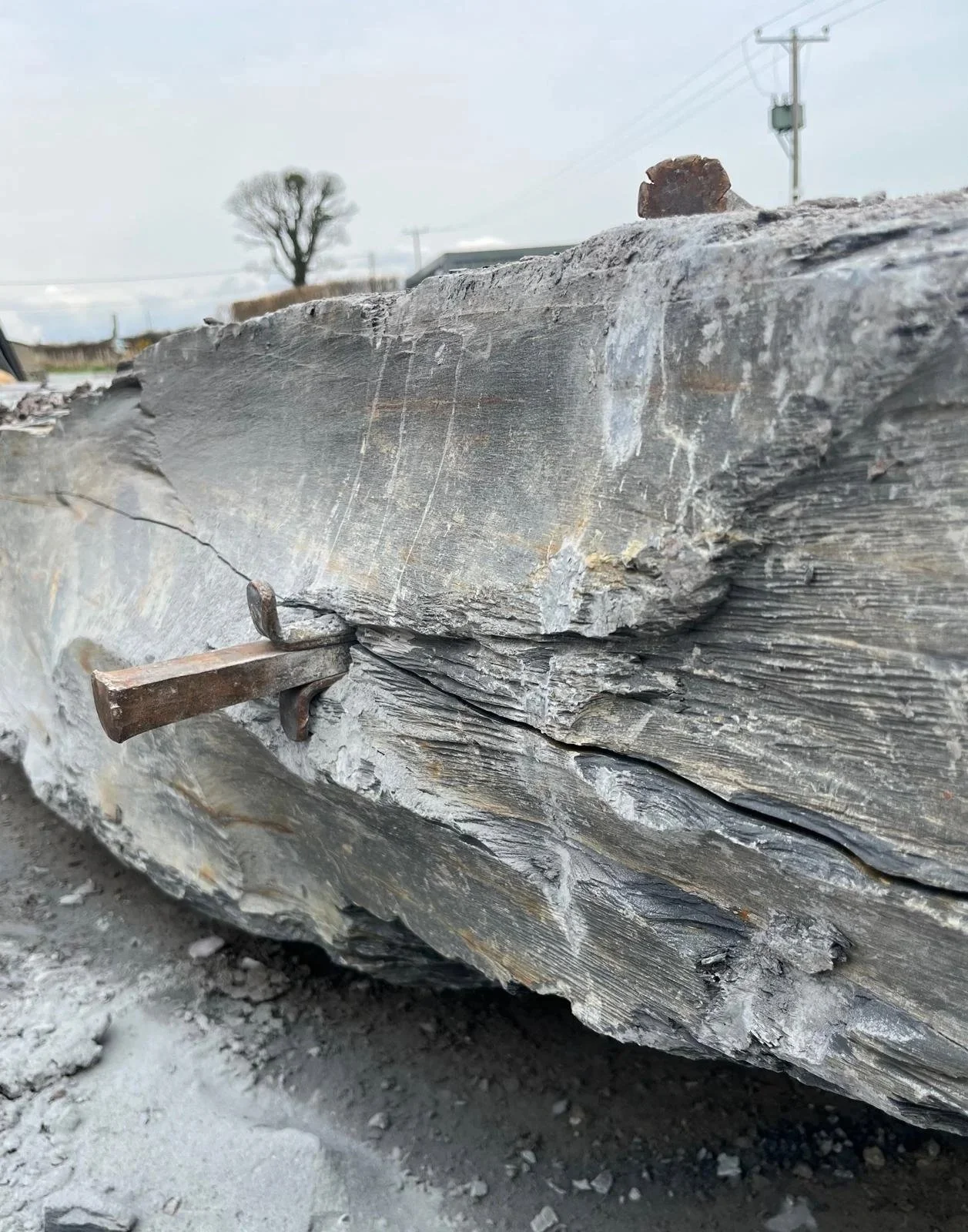
Feathers – two curved metal shims placed into a drilled hole
Plug – a wedge inserted between the feathers
Hammer – used to drive the plug and apply pressure
Together, these tools allow craftsmen to guide the stone to split cleanly and predictably, rather than shattering unpredictably.
Splitting the Slate
1. Study the Stone
Before any drilling begins, the slate is carefully studied. Welsh slate has a natural cleavage planes which is where it prefers to split. Understanding this grain is key and comes only with experience.
2. Drilling the Line
A series of evenly spaced holes are drilled along the desired split line. Accuracy here determines the success of the entire process.
3. Inserting the Feathers and Plug
Each hole is fitted with two feathers, followed by the plug. The feathers cradle the plug, directing outward force into the stone (see photo).
4. Applying Pressure
With a steady rhythm the plugs are tapped in sequence. This gradual, even pressure builds tension within the slate.
5. The Split
Then comes the moment every craftsperson listens for, a subtle crack that travels along the line. The stone separates cleanly, revealing smooth, workable faces.